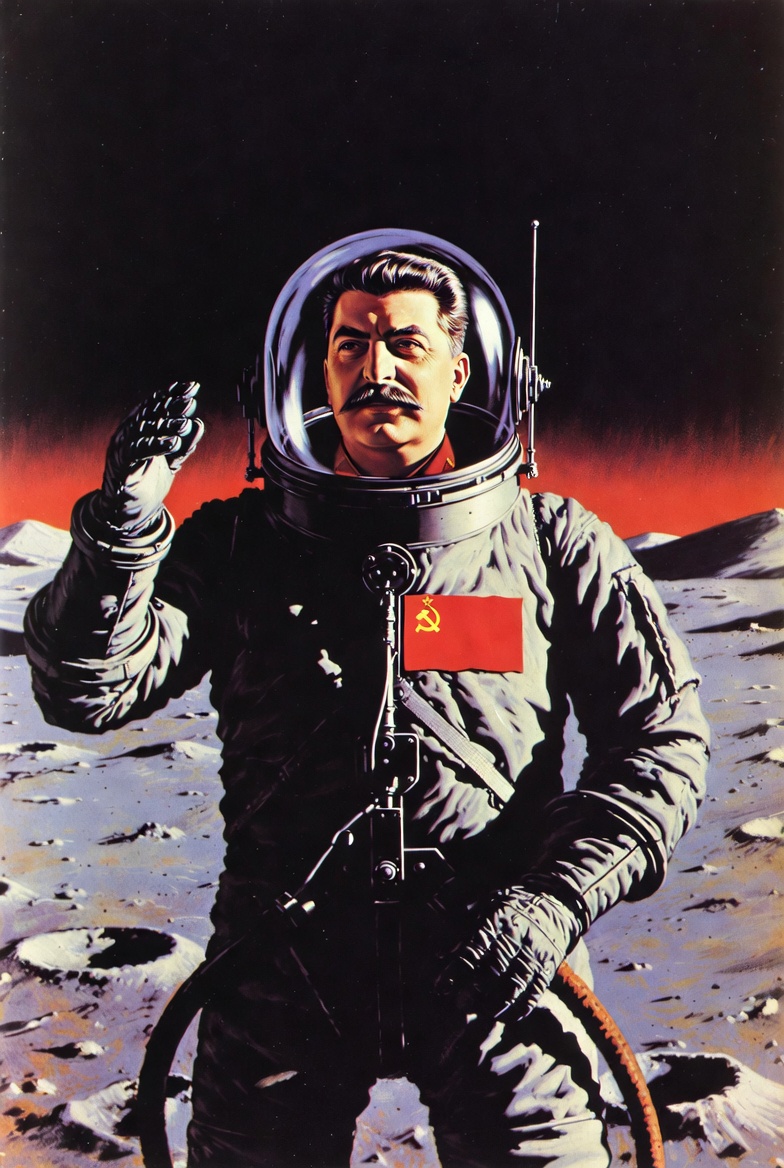
It sounds absurd.
Rockets, guidance systems and life-support—while the Soviet Union was still industrializing, starving, and purging its own elites.
But the deeper question is not whether the USSR could reach the Moon in the 1930s.
It is this:
What if the Soviet state had attempted a genuine, centralized, prestige-driven space program a generation earlier than anyone else?
Not as science fiction.
As political theater and institutional mobilization.
The answer tells us far more about how the Soviet system actually worked than about rockets.
The real hinge: prestige politics beats fear politics
The Soviet Union already had rocketry.
And it already had visionaries.
The intellectual grandfather of Russian spaceflight, Konstantin Tsiolkovsky, was famous long before Stalin consolidated power.
By the early 1930s, young engineers and amateur groups were actively experimenting with liquid-fuel rockets.
The figure who would later become the backbone of Soviet spaceflight, Sergey Korolev, was already deeply involved in early programs.
The real point of divergence is not technical.
It is political.
In this timeline, Joseph Stalin becomes convinced—early—that:
- spectacular technological firsts are as valuable as tanks
- global prestige is a strategic weapon
- and ideological legitimacy can be built through scientific triumph
Instead of treating rocketry as a military curiosity and later purging much of its talent, Stalin protects and elevates it.
The Moon becomes a symbolic target.
Not a practical one.
What a “moonshot” actually means in the 1930s
It does not mean a lunar landing.
It means a declared, centralized, state-sponsored program with one public objective:
- long-range rockets
- high-altitude flight
- and eventually, human spaceflight
In other words, the Moon is propaganda.
Orbital capability is the real goal.
The institutional shift is decisive.
Rocket groups are folded into a protected, high-priority design sector, rather than scattered and later destroyed by the security apparatus.
The first miracle: Korolev is never sent to the camps
In our history, Korolev was arrested in 1938 and sent to the Gulag, nearly dying.
In this timeline, the rocketry sector is politically protected.
Korolev is moved into a high-visibility, defense-adjacent research bureau.
This single change alone accelerates Soviet rocketry by years.
More importantly, it changes the culture of the field.
Engineers stop hiding.
They stop building personal patronage networks inside the police and party.
They build institutions.
Why the Soviet system is uniquely good at a moonshot
The Stalinist state is catastrophically bad at many things.
But it is exceptionally good at three that matter here.
- extreme resource concentration
- political insulation of favored projects
- and punishment of failure everywhere else
A prestige space program becomes a classic Soviet “special priority sector.”
It receives:
- privileged access to machine tools
- protected labor assignments
- and preferential materials allocation
Unlike consumer industry, it does not need to be efficient.
It only needs to succeed once.
What advances much earlier
With real political backing by the early 1930s, three fields jump forward.
- liquid-fuel engine development
- high-altitude test vehicles
- and guidance and telemetry systems
The first Soviet large multi-stage experimental rockets appear not in the late 1940s—but near the end of the 1930s.
They are crude.
They are unreliable.
But they exist.
That alone changes the strategic map.
But the real enemy is not technology
It is terror.
The Great Purge is the single greatest obstacle to a 1930s moonshot.
In our history, it destroyed:
- technical leadership
- continuity of teams
- and institutional memory
For the moonshot to survive, one thing must be different:
the rocketry and advanced research sector is explicitly carved out of mass political repression.
Not immune.
Protected.
The logic is brutally simple.
Killing engineers makes headlines.
Launching rockets makes history.
Why a manned program is still fantasy
Even with protection and funding, the USSR in the 1930s cannot realistically support human spaceflight.
The limiting factors are overwhelming.
- no life-support systems
- no biomedical understanding of weightlessness
- no reliable high-thrust engines
- no heat-shield technology
- and no guidance precision for reentry
But a robotic program is different.
High-altitude and sub-orbital payloads are absolutely plausible.
The real success metric becomes:
- altitude records
- ballistic range records
- and eventually, the first artificial object to reach space
Not a cosmonaut.
The first real strategic shock: an early space demonstration
By the late 1930s—if the program survives politically—the Soviet Union publicly launches:
- a high-altitude research vehicle
- reaching altitudes far beyond any aircraft
- with broadcast telemetry
The world does not see a satellite.
But it does see something clearly beyond conventional aviation.
The symbolism is explosive.
A closed, revolutionary state is now visibly touching the edge of space.
What this does to Germany and the West
This has immediate consequences for Nazi Germany and for the Western powers.
Germany already has its own rocketry ambitions.
But now those ambitions become politically urgent.
The military case for rockets becomes easier to sell when a rival regime is visibly ahead.
The result is not less militarization.
It is faster militarization.
Rocket development becomes openly tied to strategic rivalry years earlier than in our history.
World War II changes—but not in the way people expect
An early Soviet moonshot does not produce wonder weapons.
It does not stop invasions.
It does not provide battlefield dominance.
But it does quietly change one critical institutional fact:
the Soviet Union enters the Second World War with an intact, experienced, large-scale rocketry and systems-engineering community.
That matters enormously after 1945.
The postwar jump becomes terrifyingly fast
In our history, the post-war rocket race is built on:
- captured German expertise
- and hastily reconstructed Soviet institutions
In this timeline, the Soviet Union already has:
- trained systems engineers
- production pipelines
- and testing infrastructure
German technology still matters.
But it plugs into an existing framework instead of creating one.
The consequence is stark.
The first true Soviet long-range ballistic missiles appear earlier.
So do large multi-stage launch vehicles.
The real moon race moves forward by a decade
The most realistic outcome is not a 1930s Moon landing.
It is this:
everything from our real 1950s and early 1960s space race happens roughly ten years earlier.
Which means that:
- the first satellites
- the first animals in orbit
- and the first humans in space
are Soviet achievements in the late 1940s and early 1950s.
Long before the United States has politically organized itself around a peacetime science race.
What happens to the Cold War
The psychological structure of the Cold War changes immediately.
Instead of nuclear weapons being the first great technological shock of the postwar world, space becomes one of the opening symbols of rivalry.
The Soviet Union enters the Cold War with something it never truly had in our history:
- a reputation for scientific modernity
- rather than merely military brutality
That changes how newly independent states perceive Soviet power.
Prestige politics becomes real.
Not just ideological propaganda.
The darker internal consequence
There is a cost.
A protected moonshot sector becomes a model for how the Soviet state learns to govern advanced technology:
- secrecy
- internal privilege
- and extreme political insulation
The scientific elite becomes a caste.
Not a reform constituency.
Instead of liberalizing pressure from engineers and scientists, the system produces a loyal technocratic aristocracy embedded inside authoritarian power.
The state learns how to innovate without opening.
Why this does not save Soviet communism
It makes it more capable.
Not more flexible.
The fundamental contradictions remain:
- rigid political control
- distorted economic incentives
- and fear-driven decision-making outside protected sectors
A moonshot accelerates Soviet technological prestige.
It does not solve systemic stagnation.
The final irony
If the Soviets had attempted a moonshot in the 1930s, the most important change would not be the Moon.
It would be timing.
The world would learn much earlier that authoritarian systems can:
- build advanced science
- coordinate vast technical projects
- and achieve breathtaking feats
without becoming politically open.
The space age would begin not as a symbol of peaceful modernity—
but as an extension of ideological competition.
And the Cold War would start not with a bomb—
but with a rocket disappearing upward into a sky no one had yet learned how to share.
Leave a Reply