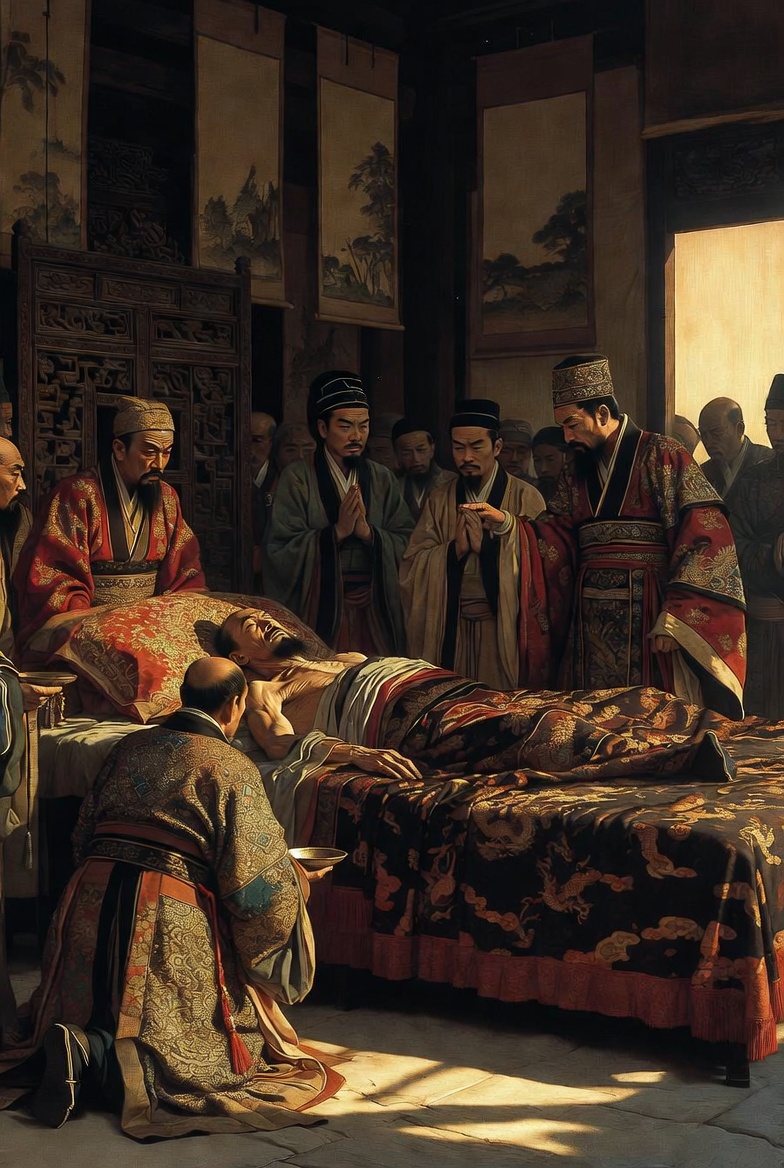
In 210 BC, the first emperor of China died suddenly.
By then, the impossible had already happened: the Warring States had been crushed, and a single court ruled the entire Chinese world.
This scenario asks a much sharper counterfactual:
What if Qin Shi Huang had died several years earlier—before consolidation—and the Qin state had failed to hold its new empire together?
Not a longer reign.
Not a gentler emperor.
An early death, followed by political collapse.
The result is not a return to the old Warring States world.
It is something far more unstable—and far more revealing about how fragile early Chinese unity actually was.
The real point of divergence: death before institutions harden
Qin Shi Huang’s unification was military.
Its survival depended on administrative and elite transformation.
That transformation was only just beginning.
In this timeline, the emperor dies:
- before large-scale relocation of noble families is completed
- before commandery administrations are fully staffed and stabilized
- before standardized law, taxation, and labor systems become routine
The conquest is finished.
The state is not.
The court in Xianyang suddenly loses the one figure who can:
- overrule regional commanders
- intimidate rival factions
- and personally arbitrate elite disputes
That vacuum is fatal.
Why Qin collapses instead of limping on
In our history, Qin still collapsed quickly.
But here, the collapse comes earlier—and more violently.
Three structural weaknesses explode at once.
- newly conquered regions still contain intact local elite networks
- Qin-appointed officials lack deep social roots outside the old Qin heartland
- the army is dispersed across the empire, not concentrated around the capital
Without the emperor’s authority, provincial commanders begin acting independently.
Not as rebels.
As temporary stabilizers.
The language of loyalty remains.
The practice does not.
The court cannot manage succession
The legalist state depends on centralized, unquestioned authority.
It is designed for obedience, not elite bargaining.
The emperor’s death produces a paralyzing problem:
- there is no trusted mechanism for power-sharing
- no tradition of ministerial autonomy
- and no accepted way to reconcile rival claims
Figures such as Li Si, the chief architect of Qin administration, attempt to hold the system together.
But the tools he possesses are:
- legal commands
- personnel files
- and punishment authority
None of these can substitute for personal political legitimacy.
The bureaucracy freezes.
The military improvises.
The empire fractures along old state boundaries
The most plausible pattern of collapse is not chaos everywhere.
It is regional reversion.
Former great states re-emerge as political centers:
- Chu in the south
- Qi in the east
- Zhao and Yan in the north
Not as exact restorations.
But as successor regimes built on:
- surviving aristocratic networks
- local military leadership
- and resentment of Qin exactions
The Qin heartland itself remains powerful.
But it is now only one contender again.
Why this does not simply recreate the Warring States
The old world cannot return intact.
Too much has changed.
Even after a short Qin rule, several irreversible shifts remain.
- weights, measures, and writing systems have already been standardized
- road and transport infrastructure now connects regions directly to former Qin command centers
- elite families have been displaced, mixed, and partially broken
Every successor regime inherits a partially Qin-shaped state.
They rule through commanderies.
They recruit through Qin-style administrative offices.
They govern populations already exposed to centralized law.
The political imagination has shifted.
The idea of empire now exists.
The key consequence: permanent competition over reunification
The collapse does not produce a balance-of-power system.
It produces a legitimacy race.
Every successor state frames its ambition in the same way:
- restoring order
- ending fragmentation
- finishing unification
Unification becomes the only credible claim to supreme authority.
Fragmentation is now ideologically temporary.
This is a crucial psychological break from the earlier Warring States era.
Why a new unifier still emerges
Within a generation, the structural pressures reassert themselves.
- interstate warfare remains brutally expensive
- mobile populations undermine local aristocratic monopolies
- administrative states outperform patrimonial ones
Eventually, one coalition of states outperforms the others.
In our history, this role was filled by the Han.
In this timeline, the identity of the victor is less certain.
But the outcome is highly likely.
A second unification still happens.
What changes is who designs it.
The most important difference: the new empire is not Legalist in spirit
The Qin collapse permanently discredits extreme Legalism as a ruling ideology.
Not because it was cruel.
But because it is seen as politically brittle.
Later unifiers draw a very different lesson:
- coercion alone cannot stabilize a continental empire
- elite cooperation must be institutionalized
- moral and ritual legitimacy must supplement law and punishment
Thinkers associated with softer statecraft, compromise, and moral authority gain political value.
The new empire is still authoritarian.
But it is ideologically blended.
What happens to Confucianism
This collapse radically accelerates the rehabilitation of Confucian political ideas.
Legalism had proven it could conquer.
It has now proven it cannot endure.
The future ruling elite increasingly demands:
- ethical language for authority
- ritualized hierarchy to bind officials to the court
- and cultural legitimacy that can travel beyond coercive enforcement
This is the opening that allows Confucian-trained officials to become indispensable to the next dynasty.
Not as philosophers.
As stabilizers.
The deeper institutional shift: bureaucrats learn to defend themselves
Qin bureaucracy is designed to obey.
The post-Qin bureaucracies learn a different survival skill:
- how to embed themselves inside multiple regional regimes
- how to serve changing rulers without being purged
- how to become administratively irreplaceable
This produces a class of professional officials who are no longer tied to a single state.
They become the connective tissue of future empires.
The long-term shape of Chinese political history
Paradoxically, an early Qin collapse does not weaken the case for Chinese unity.
It strengthens it.
But it reshapes how unity is built.
Instead of:
- extreme centralization
- personal authority at the top
- ideological uniformity
the later empire is founded on:
- elite co-option
- layered administration
- and shared cultural legitimacy
The state becomes more resilient.
Because it is less absolute.
The final irony
If Qin Shi Huang dies early and his empire collapses, the world does not become less imperial.
It becomes more cautious about how empires are built.
In our history, the first empire was created by force and refined by experience.
In this timeline, the first empire fails—and teaches its successors how not to repeat its mistake.
China still reunifies.
But it does so under a political culture that learned its most important lesson not from success—
but from collapse.
Leave a Reply