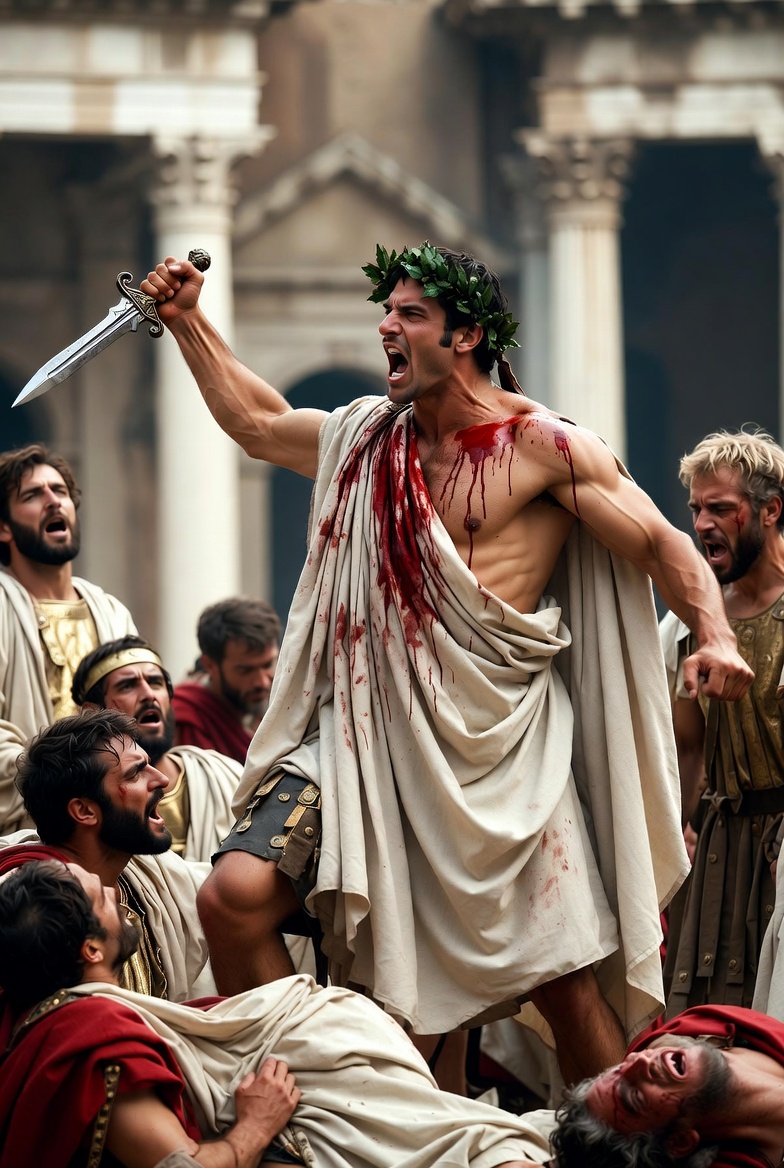
In March 44 BC, the Roman Republic killed the one man who had already broken it.
This scenario asks a harder and more interesting question than “what if he wasn’t assassinated?”:
What if Julius Caesar had lived long enough to rule—and actually institutionalize his power?
Not as a king.
Not as a passing strongman.
But as the founder of a new, stable political order.
The real point of divergence: Caesar takes the threat seriously
In this timeline, Caesar does not ignore warnings about the Ides of March.
He does not stage a purge.
He does not abandon clemency.
He makes three quiet, very Roman adjustments:
- he replaces personal bodyguards with a rotating mixed Italian and provincial guard
- he stops concentrating daily business in open senatorial settings
- he accelerates departure plans for the eastern campaign, but leaves behind a formally empowered governing council
The conspirators never find a clean moment.
The crisis does not explode.
It curdles.
What Caesar actually wanted to build
It is easy to imagine Caesar simply ruling forever as a benevolent autocrat.
That misunderstands his problem.
Caesar does not need power.
He already has it.
He needs legitimacy that can survive him.
His real objective becomes:
- ending competitive civil war as a political tool
- stabilizing elite careers without constant military commands
- and neutralizing the Senate as a rival executive body without abolishing it
In short:
he needs a monarchy that refuses to call itself one.
The first structural reform: the Senate becomes administrative
Caesar does not dissolve the Senate.
He hollows it out.
Over several years, he pushes three changes:
- the Senate’s legislative role becomes largely advisory and regulatory
- real executive authority moves into permanent magistracies and boards appointed directly by the dictator
- senatorial prestige becomes tied to provincial administration and infrastructure, not foreign policy
The Senate becomes something closer to a senior civil service.
Still aristocratic.
Still socially dominant.
But no longer sovereign.
This is a crucial psychological concession to Roman tradition.
The second reform: the army is detached from politics
This is the most dangerous part.
Caesar understands better than anyone that Rome is now ruled by whoever commands loyal legions.
He moves carefully.
He does not demobilize.
He restructures.
Over a decade, he implements:
- fixed-length provincial commands
- centralized pay and bonus systems controlled from Rome
- and a growing use of non-Italian legions rotated far from their recruiting regions
The objective is simple:
- loyalty to the state payroll
- not loyalty to a charismatic commander
This does not end military politics.
But it blunts it.
The third reform: mass citizenship as a stabilizer
Caesar already began expanding citizenship and elite inclusion.
In this timeline, he goes further and faster:
- large-scale integration of provincial elites into Roman political life
- accelerated municipal self-government in Gaul, Spain, and the Greek East
- systematic recruitment of administrators from non-Italian backgrounds
This changes the balance of Roman politics.
The core aristocracy becomes a shrinking fraction of the ruling class.
Caesar is building a new elite coalition.
One that owes him its careers.
What happens to the old republican opposition?
Figures like Marcus Tullius Cicero survive.
They write.
They complain.
They grumble in safe company.
But their political leverage collapses.
Without Caesar’s assassination, the moral high ground of “saving the Republic” never materializes.
There is no trauma to organize around.
There is no founding martyrdom for constitutional resistance.
The opposition becomes cultural rather than operational.
The problem Caesar still cannot escape: succession
This is where the real history usually breaks.
Caesar has no legitimate adult son.
In our world, the vacuum is filled by Augustus through civil war.
In this timeline, Caesar confronts the problem openly.
He begins preparing an heir while alive.
But not as king-in-waiting.
As first administrator among equals.
The most plausible outcome is not exclusive reliance on one young successor.
It is a hybrid solution:
- a publicly designated principal successor
- supported by a small ruling council of senior commanders and administrators
- all appointed and promoted by Caesar himself
This is not a dynasty.
It is a managed oligarchy under a permanent strong executive.
Does that successor still look like Augustus?
Possibly.
But the role would be very different.
Without a post-assassination civil war:
- there is no justification for massive personal military buildup
- no proscriptions
- no triumviral terror
- no emotional narrative of rescuing the state
The successor inherits:
- a functioning executive system
- a disciplined army structure
- and a Senate already accustomed to subordination
The transition becomes administrative, not apocalyptic.
What happens to Caesar’s eastern war?
He still likely campaigns against Parthia.
But its strategic meaning changes.
It is no longer:
- a desperate grab for glory
- or a distraction from domestic instability
It becomes:
- prestige management
- border stabilization
- and elite reward through command rotation
The empire expands more cautiously.
Caesar’s priority is not conquest.
It is control of the political center.
How different is this from the real Principate?
Superficially, not very.
Structurally, it is crucially different.
In our history, the imperial system is born from:
- fear
- exhaustion
- and the memory of mass bloodletting
In this timeline, it is born from:
- negotiated adjustment
- elite co-option
- and gradual normalization
That affects everything.
Especially how later rulers behave.
The key cultural shift: power becomes boring earlier
One of Augustus’ greatest achievements was making extraordinary power look routine.
Caesar would have done this sooner—and more openly.
The office of permanent executive authority becomes:
- expected
- bureaucratized
- and socially acceptable
Not masked behind repeated “restorations of the Republic”.
The hypocrisy phase is shorter.
The system stabilizes faster.
What Rome looks like by roughly 25 BC
After two decades of uninterrupted rule and managed transition, Rome is:
- an autocratic state with republican decoration
- governed by permanent executive offices
- staffed by a multinational elite
- defended by a salaried, rotated, centrally managed army
It is already an empire in political form, not just in territory.
But it is an empire that never had to cleanse itself in civil war to get there.
The deeper consequence: no founding trauma
The most important difference is emotional, not institutional.
In our history, the early empire is shaped by:
- the memory of Caesar’s murder
- the terror of the proscriptions
- and the fear that chaos could always return
In this world, the ruling class never experiences that shock.
Which produces a very different elite psychology:
- less paranoia
- less obsession with personal loyalty networks
- more reliance on formal career paths
The state becomes procedural earlier.
The final irony
Caesar is remembered in our world as the man who destroyed the Republic.
In this world, he would be remembered as something much rarer and more dangerous:
the man who made ending it look reasonable.
Not through terror.
Not through revenge.
But by demonstrating that a post-republican Rome could function—quietly, legally, and without needing another generation of civil war to accept it.
Leave a Reply