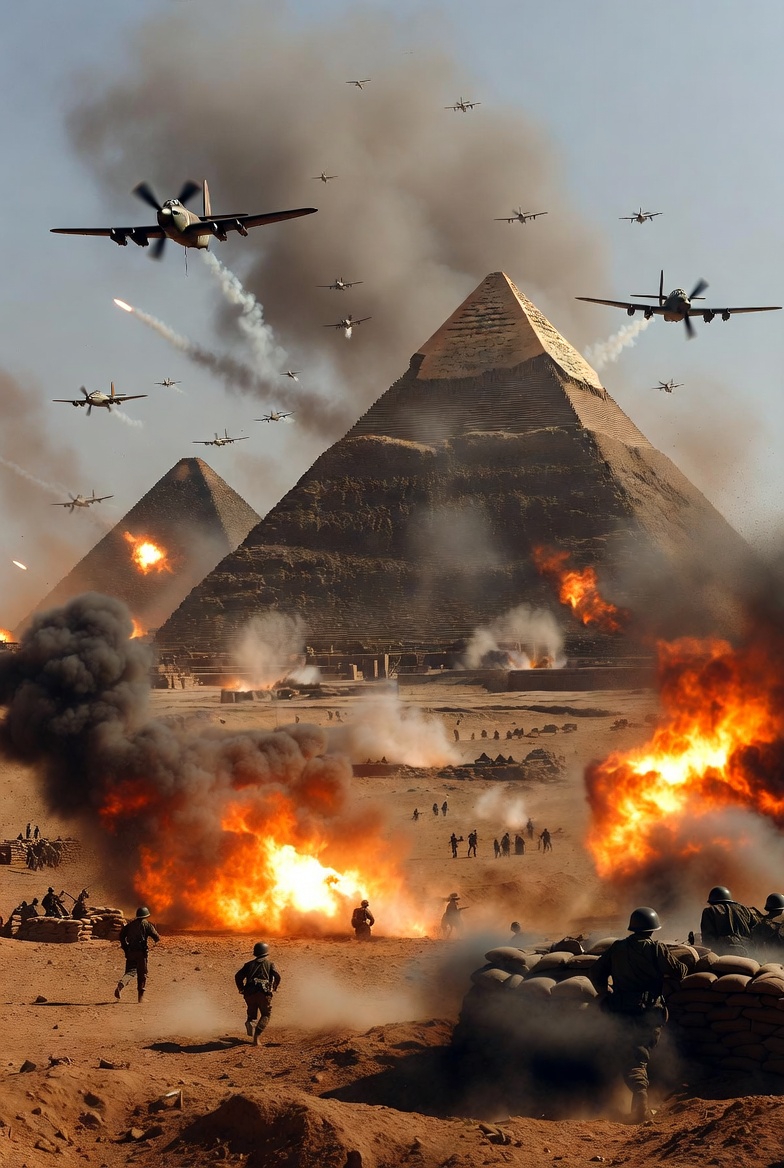
After France fell in June 1940, Adolf Hitler faced a strategic choice that still fuels endless debate.
In our timeline, Germany spent the second half of 1940 trying to neutralize Britain and then pivoted toward the Soviet Union.
In this timeline, Hitler decides something very different right away:
Don’t chase a direct knockout of Britain.
Strangle Britain’s empire instead.
That means a Mediterranean-first plan aimed at four pressure points:
Gibraltar, Malta, Egypt, and the Middle East.
It’s a strategy that looks seductive on a map, terrifying in British Cabinet rooms, and brutally difficult in practice.
Here’s how it might actually play out.
The core idea
If the Axis can dominate the Mediterranean and seize the Suez Canal, Britain loses the shortest route to:
- India and the Far East
- Middle Eastern oil
- and imperial shipping lines that keep the war economy breathing
At the same time, if Gibraltar is closed, the Royal Navy’s Mediterranean fleet is trapped or forced to retreat.
The war doesn’t end.
But Britain becomes a weaker, poorer, and more defensive power.
That’s the bet.
Summer 1940: Germany turns south immediately
Hitler’s first move is not more air war over Britain.
It’s a diplomatic and logistical shove:
- pressure Spain to allow a German move across the Pyrenees
- send heavy air assets to the western Mediterranean
- expand submarine activity around Gibraltar and the western approaches
- and begin treating the Mediterranean as a primary theater, not Italy’s side show
This is where the plan hits its first hard wall.
Spain.
The Gibraltar problem
Taking **Gibraltar is possible on paper.
But it depends on **Francisco Franco cooperating, because Germany needs transit, supply access, and political cover.
If Franco refuses (as he likely still would), Germany has three bad options:
- Threaten Spain and risk turning the Iberian Peninsula into a guerrilla and supply nightmare
- Try to seize Gibraltar without Spain’s full cooperation, which is operationally messy
- Abandon Gibraltar and accept that the Royal Navy can still flow in and out
In the most favorable version of this timeline, Franco grudgingly permits “limited” transit and support in exchange for massive economic aid.
Germany attempts the Gibraltar strike anyway.
If it succeeds, the Mediterranean becomes an Axis lake in theory.
In practice, the sea is still full of British submarines, aircraft, and mines.
The Malta problem
Even if Gibraltar is neutralized, the Axis still faces the same bleeding artery as in real history:
Malta.
As long as Malta is active, it acts like a knife held over Axis shipping routes to North Africa.
If Hitler is truly Mediterranean-first, he must do what the Axis never managed to do decisively:
make Malta unusable.
That likely requires:
- a sustained air campaign
- combined naval pressure
- and eventually a risky amphibious operation
If Malta holds, everything else gets harder.
If Malta falls, North Africa becomes far more supply-stable.
This single outcome determines whether the Mediterranean strategy becomes viable or becomes a slow-motion disaster.
North Africa becomes Germany’s main effort
With Malta suppressed or neutralized, Germany sends far more than a “limited” expedition to help Italy.
Instead of a modest reinforcement, **Erwin Rommel receives:
- stronger armored formations
- deeper logistics support
- and consistent fuel and ammunition flow
The Axis goal is no longer “hold Libya.”
It is:
break Egypt.
Once the Axis mass is sufficient, the campaign becomes a race for Alexandria and Suez before Britain can reinforce heavily.
The battles are still brutal.
The desert is still enormous.
But the Axis is no longer fighting with one hand tied behind its back by shipping losses and half-measures.
Britain’s response is immediate and existential
London treats this as a direct attack on imperial survival.
That changes British behavior.
You’d see:
- emergency reinforcement of Egypt at the expense of other theaters
- intensified convoy protection
- greater willingness to accept naval losses to keep the Mediterranean open
- and expanded operations against Axis supply lines from every angle
Britain also leans heavily on its comparative advantage:
the Royal Navy’s ability to move strength rapidly between oceans.
Even weakened, British sea power is the one thing Germany cannot match.
The Middle East opens as a second front
If the Axis drive into Egypt looks credible, the political temperature rises across the Arab world.
Anti-British movements in places like Iraq become much more dangerous.
But there’s a catch:
Germany can’t just “march to oil.”
To exploit Middle Eastern instability, it needs:
- secure supply corridors
- political partners who can actually hold territory
- and either Turkish cooperation or a path through the Levant
That means the Axis strategy becomes dependent on regional politics.
And regional politics are unreliable.
The Turkey bottleneck
To go beyond Egypt into the Levant and Iraq in a serious way, the Axis either needs:
- Turkey to join or grant passage, or
- a major campaign through Syria and Palestine under constant naval and air threat
Turkey is cautious and survival-focused.
It does not want to bet its existence on a German promise.
So the Middle East campaign becomes a struggle not just against British forces, but against geography and diplomacy.
Without Turkey, the Axis can still threaten the Middle East.
But it cannot reliably occupy it.
Meanwhile, the Balkans become even more important
To stabilize the Mediterranean, Germany still cannot ignore:
- Greece
- Yugoslavia
- the vulnerability of Romania’s oil routes
So you still get Balkan operations.
But the purpose changes.
Instead of being a prelude to Barbarossa, the Balkans become:
the security belt protecting the Axis southern strategy.
This pulls German resources into a region that is notorious for grinding down occupiers.
Does the Soviet Union stay quiet?
This is the strategic wild card.
If Germany delays or avoids attacking the Soviet Union, Moscow gains time to:
- modernize forces
- expand influence pressure
- and strengthen its own strategic position
But the Soviets are not automatically a partner of Britain.
They are opportunists.
If Germany looks bogged down in the Mediterranean, the Soviets may:
- demand more concessions
- seize opportunities on their periphery
- or simply wait until Germany is overstretched
A Mediterranean-first Germany is betting that it can weaken Britain before it must confront the Soviet threat.
That is not guaranteed.
The most likely mid-war outcome
Even in a strong Axis performance, a Mediterranean strategy does not “defeat” Britain quickly.
What it plausibly does is create a 1941–1942 world in which:
- Britain is under severe imperial strain
- the North African theater is far larger and more decisive
- the Middle East becomes politically unstable earlier
- and Germany is less committed in the east, at least temporarily
If the Axis takes Suez, Britain’s prestige is badly damaged and its logistics become harder.
But Britain does not collapse.
It reroutes trade around Africa, leans harder on its navy, and fights on with a more defensive posture.
The big tradeoff for Germany
Germany gains the chance to strangle Britain’s empire.
But it pays for that chance in two currencies it never had enough of:
- logistics
- and time
The Mediterranean is a supply war.
It is dominated by shipping capacity, port throughput, fuel, and air-sea coordination.
Germany was not built for that kind of war.
Britain was.
So the Mediterranean-first strategy is a gamble that Germany can win a naval-logistical contest indirectly, using airpower and positional captures to compensate for not being a true maritime power.
Sometimes gambles pay off.
Sometimes they just move the point of failure.
The short answer
If Hitler went Mediterranean-first after France, the war’s center of gravity shifts sharply south:
Gibraltar and Malta become decisive targets, North Africa becomes Germany’s main front, Egypt and the Suez Canal become the strategic prize, and the Middle East becomes a destabilized battleground rather than a distant flank.
Britain likely becomes weaker and more defensive earlier.
But Germany’s fundamental problem remains:
the Mediterranean strategy is only as strong as the Axis ability to supply it, and supply is exactly where a continental power tends to break.
Leave a Reply