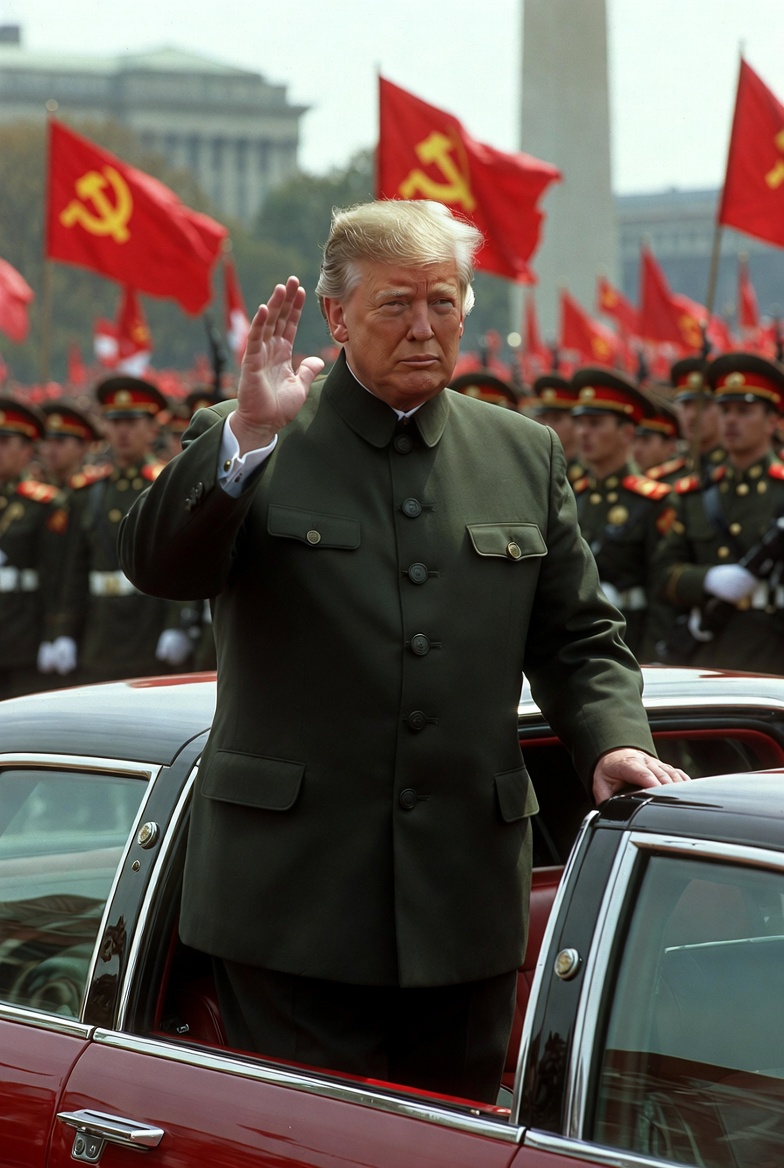
This is one of the few counterfactuals that sounds absurd at first—and becomes disturbingly plausible once you anchor it in real political stress.
The question is not whether the United States suddenly turns into a Soviet clone.
It is whether a coalition of crisis politics, labor radicalization, and elite fracture could have produced a recognizably communist state in America between roughly 1932 and 1948.
This scenario asks:
What if the United States, under extreme pressure, crossed that line?
The only window where this is remotely plausible
There is really only one opening.
The Great Depression.
By 1932:
- industrial output had collapsed
- millions were unemployed
- local relief systems were breaking down
- veterans were marching on Washington
The political center was fragile in a way that never reappeared later.
The key hinge is not revolution in the streets.
It is elite failure at the top.
The point of divergence is this:
Franklin D. Roosevelt fails to stabilize the economy and loses elite confidence by 1934–35.
Not because he is less skilled.
But because:
- the banking system fractures again after initial reforms
- agricultural price stabilization fails badly
- and a second financial panic hits before recovery begins
The New Deal is now seen as incompetence rather than rescue.
The left was real – and already organized
This is often misunderstood.
The American far left in the 1930s was not imaginary.
The most important institutional vehicle was the Communist Party USA.
At its peak influence, it had:
- deep penetration in industrial unions
- real influence in cultural and academic institutions
- disciplined national organization
- and international backing
Its leader in this period, Earl Browder, was not a revolutionary romantic.
He was a coalition operator.
The American communist strategy was never insurrection.
It was capture.
The real mechanism: labor radicalization plus party collapse
The realistic path looks like this.
Not a civil war.
A political realignment that goes off the rails.
Three things happen together.
- the Democratic Party fractures between business liberals and militant labor blocs
- the Republicans disintegrate as a national governing party after repeated economic failures
- industrial unions consolidate into a single militant front
Instead of communists forming a mass party on their own, they embed inside:
- labor federations
- local Democratic machines
- and progressive third-party movements
A national “workers’ party” emerges by merger, not by declaration.
Its leadership is mixed.
But its organizational spine is communist.
The 1936 election becomes the pivot
Instead of Roosevelt’s landslide, you get a three-way collapse.
The radical-labor coalition runs a unity candidate.
The establishment vote splits.
The result is not a clean revolutionary mandate.
It is a legitimacy crisis.
Congress becomes ungovernable.
State governments in parts of the Midwest, West Coast, and Northeast begin coordinating their own emergency economic programs:
- price controls
- state-owned utilities
- public banking
- industrial planning boards
The federal center begins to hollow out.
The constitutional trap
This is where the American path becomes uniquely dangerous.
The US system is designed to block fast political transformation.
But under crisis, that can produce something worse than gridlock.
It produces emergency improvisation.
By the late 1930s:
- large-scale federal industry coordination exists outside clear constitutional authority
- executive agencies regulate entire sectors without stable statutory foundations
- courts are increasingly bypassed rather than confronted
A political culture of emergency administration takes root.
That becomes the legal doorway.
The moment that breaks the dam: war mobilization
The decisive accelerator is war.
Once the United States begins large-scale mobilization for the Second World War, the machinery needed for a command economy already exists.
In this timeline, that machinery is captured politically.
A coalition government is formed in Washington that openly includes communist-aligned labor leadership.
Not because voters suddenly embrace Marx.
But because:
- labor controls production continuity
- the military depends on uninterrupted industrial output
- and elite coordination is failing
Emergency powers normalize something that would otherwise be impossible.
How the Communist turn actually happens
There is no declaration of a “People’s Republic”.
Instead, a new governing doctrine emerges.
Its language is American.
Its substance is socialist.
The reforms are presented as permanent extensions of wartime necessity.
The core moves look like this:
- nationalization of rail, energy, and major steel and armaments producers
- creation of a federal employment guarantee system
- mandatory sectoral planning boards with binding authority
- integration of unions into management and oversight structures
Private property continues to exist.
But strategic industry does not.
The economy becomes hybrid in theory and socialist in practice.
What happens to the Constitution?
It is not abolished.
That is crucial.
Instead:
- congressional authority is hollowed out by emergency delegation
- executive agencies become quasi-legislative
- and the Supreme Court is politically reshaped through rapid appointment turnover
The system survives formally.
But sovereignty migrates into administrative institutions.
This is far closer to how communist systems actually consolidated in parts of Eastern Europe than to how Americans usually imagine revolution.
Why this does not become Stalinism
This is not a terror state.
It cannot be.
The institutional environment is wrong.
There is:
- no single ruling party monopoly at the beginning
- no unified security apparatus loyal to a revolutionary leadership
- no tradition of mass ideological discipline
The American communist regime would be:
- factional
- legally messy
- and permanently constrained by federalism
But it would still be recognizably socialist.
The great internal struggle
The central political fight of this new America is not left versus right.
It is:
communist administrators versus social-democratic labor managers.
The communists push for:
- tighter central planning
- nationalization of finance
- unified political control over unions
The labor-wing reformers push for:
- decentralized sectoral bargaining
- co-determination rather than ownership
- and plural party competition
This internal struggle defines the regime.
What happens to opposition?
Conservative politics does not disappear.
But it is reorganized.
Opposition survives mainly through:
- state governments
- business associations
- religious and civic organizations
The battlefield is administrative law, not street protest.
The system evolves into something closer to:
a managed ideological pluralism under an overwhelmingly left economic framework.
The international shock
The global consequences are enormous.
The relationship with the Soviet Union is fundamentally transformed.
Instead of ideological rivalry, you get:
uneasy alignment.
Joseph Stalin does not trust the American system.
But he cannot ignore it.
The Cold War, as we know it, never forms.
Instead, the world divides very differently.
Western Europe no longer needs American capitalist sponsorship to justify its own welfare states.
Communist parties in France and Italy become legitimate governing partners far earlier and with less fear.
The biggest structural irony
A communist United States would not export revolution.
It would export standards.
What spreads is not insurrection.
It is:
- industrial planning techniques
- labor integration models
- state financial instruments
American administrative capacity becomes the model.
Not Moscow’s.
The long-term shape of American society
By the 1950s, this United States looks like:
- economically egalitarian by historical standards
- politically noisy and factional
- culturally liberal but institutionally conformist
Most citizens experience the system as stability, not ideology.
Jobs exist.
Housing is regulated.
Healthcare is regionally administered.
Political identity becomes less about capitalism versus socialism—and more about how centralized the system should be.
Why this path closes after 1950
The reason this only works in the early–mid 20th century is simple.
After sustained growth:
- mass middle-class property ownership explodes
- private credit markets deepen
- and political legitimacy recenters around consumption rather than security
Once prosperity becomes the organizing myth, socialist capture becomes dramatically harder.
This counterfactual lives only inside a narrow window of prolonged crisis.
A quiet transformation
If America had gone communist, it would not have looked like a revolution.
It would have looked like a labor-backed administrative takeover during national emergency.
The deepest transformation would not be ideological.
It would be institutional.
In this world, Americans do not stop believing in freedom.
They simply redefine it—quietly and permanently—as freedom from economic insecurity rather than freedom from the state.
The biggest difference: work is a right, not a market outcome
In this America, the defining civic promise is:
- you will always have a job
- the state (or a public enterprise) is the employer of last resort
- long-term unemployment is treated as administrative failure
Today, that means:
- career paths are more planned and less chaotic
- large labor-allocation systems guide people into shortages
- retraining is automatic and paid
- layoffs exist, but you are immediately reassigned
Job hunting culture as we know it barely exists.
Pay is flatter and status is less financial
Income differences still exist, but:
- executive pay is tightly regulated
- sector-wide pay scales dominate
- bonuses are collective, not individual
The social result:
- doctors, engineers, managers and senior officials live well
- but not spectacularly better than skilled technicians
What replaces money as status markers:
- professional rank
- certification level
- responsibility tier
- and institutional prestige
People care more about where they sit in the system than what they own.
Housing looks radically different
There is no large private real-estate investment market.
Most housing is:
- publicly built
- municipally owned
- or cooperative
In practice:
- you apply for housing through your employer or municipality
- relocation for work comes with guaranteed housing
- homelessness is administratively rare
You still own personal property.
You usually do not speculate on housing.
Suburbs still exist — but they are planned suburbs, not developer-driven ones.
Healthcare is simply part of citizenship
Not an insurance system.
Not employer-linked.
Not something you shop for.
Instead:
- regionally run public systems
- national standards
- automatic enrollment at birth
Your experience:
- no bills
- no networks
- no financial triage decisions
The tradeoff:
- slower access to some high-demand specialists
- less boutique medicine
- less consumer choice
But far more uniform outcomes.
Education is tightly linked to labor planning
University is not a personal investment gamble.
It is a national capacity decision.
That means:
- admissions are coordinated with projected labor demand
- tuition is free
- placement into public employment is largely automatic
You still choose fields.
But:
- your chances of entry are shaped by national planning needs
- not by your ability to pay
Elite universities still exist.
They function more like civil-service academies than prestige brands.
You own things — but you don’t build wealth the same way
You still own:
- consumer goods
- vehicles
- personal savings
- cooperatively owned shares
But:
- you do not build large private investment portfolios
- you do not become wealthy through real estate or stock markets
- finance is overwhelmingly public
Most personal security comes from:
- guaranteed employment
- housing security
- public pensions
Wealth accumulation is socially marginal.
Security replaces upside.
Politics feels noisy — but less existential
This is not a one-party state.
It is a heavily managed multi-faction system.
The main political battles are:
- central planners vs regional autonomy blocs
- union federations vs administrative agencies
- professional associations vs industrial ministries
So elections revolve around:
- how centralized planning should be
- how much authority unions should retain
- how much local governments can override national plans
What almost nobody runs on:
- privatization of core industry
- dismantling public employment guarantees
- market-driven healthcare
Those are outside the political mainstream.
Business culture barely resembles today’s startup economy
Most large firms are:
- public enterprises
- or heavily regulated cooperatives
- or mixed public–labor ownership structures
That means:
- no venture capital culture
- very limited speculative entrepreneurship
- innovation happens mainly through:
- public R&D institutes
- sector research boards
- university–industry partnerships
New products still appear.
But they are introduced through institutional channels, not founder mythology.
The culture around “freedom” is quietly different
People still talk about freedom.
But what they mean is:
- freedom from economic catastrophe
- freedom from medical ruin
- freedom from housing insecurity
- freedom from employment precarity
Not primarily:
- freedom from regulation
- freedom from state involvement
The state is not experienced as a distant authority.
It is experienced as infrastructure.
Media and culture are less commercial, more institutional
Most major media outlets are:
- publicly funded
- union-run
- or cooperative cultural institutions
They are:
- politically plural
- often critical
- but structurally embedded in public systems
There is less sensational market-driven news.
More slow, policy-heavy coverage.
More cultural programming.
Less algorithmic outrage economics.
The United States’ global position feels very different
In this world, the United States is not the symbolic champion of capitalism.
It is the world’s largest and most technically advanced planned economy.
Its influence is exported through:
- industrial standards
- infrastructure packages
- labor integration models
- public finance tools
Not through deregulation or market reform advice.
Many countries copy American-style public sector management rather than Soviet-style party control.
The biggest everyday psychological difference
Probably this:
People grow up assuming their life will be structurally stable.
Not necessarily exciting.
Not necessarily upwardly explosive.
But predictable.
You still compete.
You still fail.
But you rarely fall out of the system.
The hidden cost
The main thing people in this America quietly complain about is:
- slowness
- bureaucracy
- institutional conservatism
Changing careers is possible.
Reinventing yourself dramatically is harder.
Radical personal economic success stories are rare.
So are catastrophic failures.
The final, simple contrast
In our world, daily life is shaped by:
markets allocating risk.
In this world, daily life is shaped by:
institutions absorbing risk.
Most Americans today would experience this system less as “communism”—
and more as a very large, very competent, very unavoidable employer that quietly runs most of the background of their lives.
Leave a Reply