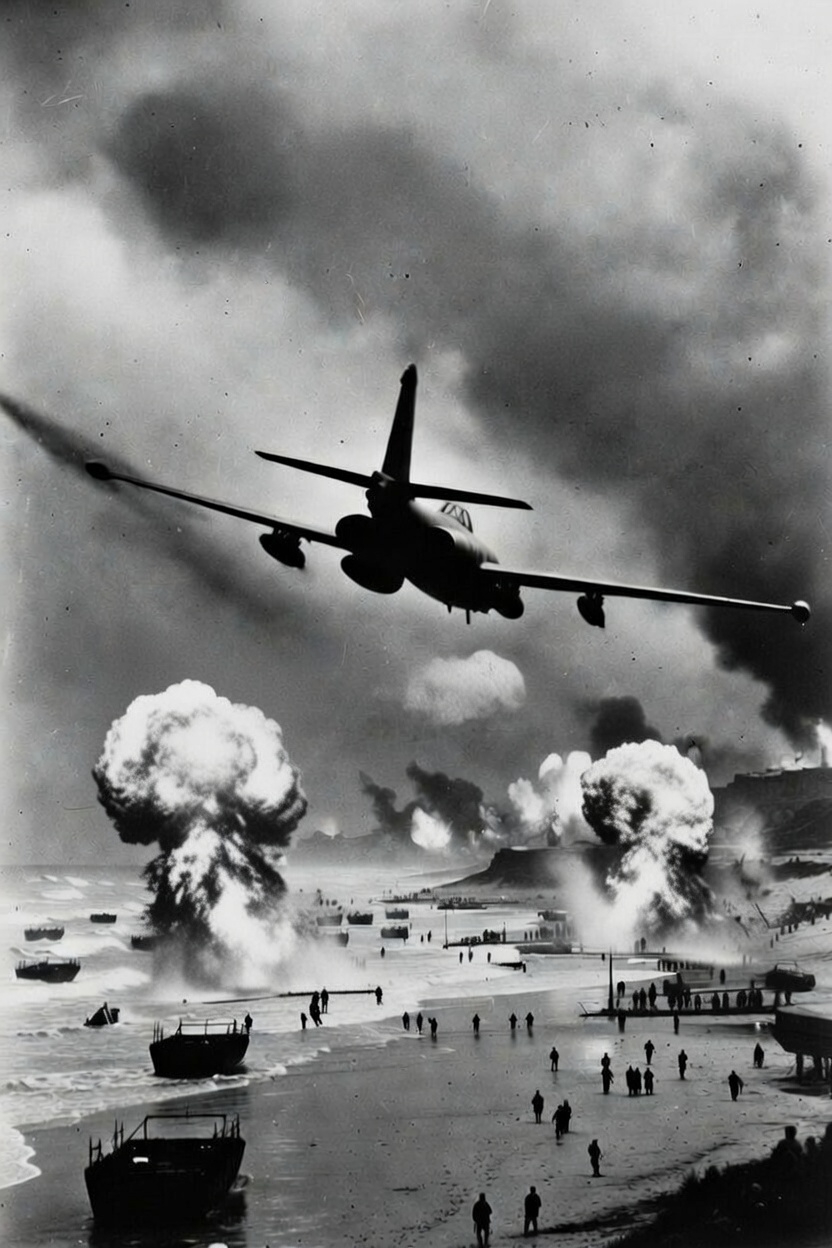
The Third Reich’s most famous “wonder weapons” were not imaginary.
Jet fighters, ballistic missiles, and revolutionary submarines all existed. They simply arrived too late, and in too few numbers, to matter.
This scenario asks a narrower and more realistic question:
What if Germany’s advanced weapons programs had been pushed forward by just two or three years?
Not miracle science.
Not radically different designs.
Just earlier political commitment, stable requirements, and production planning before the war began.
The result is a much more dangerous Germany — but still not a victorious one.
The political shift that makes it possible
The key change happens in 1938–39.
Instead of treating advanced aircraft and rockets as prestige projects, Adolf Hitler is persuaded that long-range strike systems, advanced interceptors, and next-generation submarines are strategically decisive.
That single shift unlocks three things:
- early access to skilled labor
- protection from internal sabotage and design reversals
- early industrial planning
The engineering talent already existed.
The bottleneck was political priority.
The three systems that actually matter
Jet fighters become operational in 1942
Germany’s jet fighter program, especially the Me 262, is stabilized early and authorized purely as an interceptor.
In this timeline:
- final design is frozen by 1940–41
- pilot conversion and maintenance training begins in 1941
- front-line squadrons appear by mid-1942
Against bomber forces in 1942–43, early jets:
- climb faster than any escort fighter
- attack bomber formations with heavy cannon
- disengage almost at will
The Allied bombing campaign does not stop.
But loss rates rise sharply, especially before long-range escorts are fully available.
The V-2 enters service while Britain is still fighting alone
Germany’s ballistic missile program already existed before the war.
Its central technical figure was Wernher von Braun.
With stable funding and political protection, operational missiles appear by late 1941 or early 1942.
Southern England and London come under attack:
- without warning
- without intercept
- at a moment when Britain still feels strategically isolated
Militarily, the weapon is inefficient.
Politically and psychologically, it is deeply unsettling.
The advanced submarine arrives before Allied anti-submarine dominance
The real strategic shock comes from submarines, not rockets.
The new electric boat design — the later Type XXI — is introduced in quantity in 1942 instead of 1944–45.
These submarines:
- remain submerged almost continuously
- move faster underwater than existing escorts
- can reposition and attack without exposing themselves
For roughly a year, Allied anti-submarine methods lag badly behind the threat.
How the war changes in practice
1942: Britain faces a much darker year
- missile attacks begin hitting British cities
- jet fighters begin attacking bomber streams
- shipping losses in the Atlantic rise sharply
In London, Winston Churchill confronts a familiar fear: not invasion, but slow strangulation.
- food stocks tighten
- fuel reserves become politically sensitive
- repair and reconstruction struggle to keep pace
Britain is not collapsing.
But confidence is shaken in a way it was not in our timeline.
1943: the air war becomes a grinder
Early jets force changes in Allied bombing tactics.
- loss rates increase
- daylight bombing becomes more contested
- escort fighters are rushed into service and deployed more aggressively
Under Franklin D. Roosevelt, the United States does not back away.
But:
- the air campaign no longer produces results as quickly as planners expect
- the timetable slips
1942–43: the Atlantic nearly breaks
The early arrival of advanced submarines creates a short but extremely dangerous window.
Convoys begin losing ships even in areas thought to be secure.
The consequences are immediate:
- troop movements slow
- import schedules tighten
- shipbuilding and escort construction become even higher priorities than in real history
This is one of the few periods in the war when Allied planners privately fear not defeat, but prolonged strategic stalemate.
Why this still does not give Germany victory
Even with all three breakthroughs arriving early, Germany cannot escape four structural limits.
Industrial scale
Jets, rockets, and advanced submarines are expensive and labor-intensive.
- Germany cannot produce them in numbers remotely comparable to Allied aircraft, ships, and escorts
- one advanced weapon can change a battle
- it cannot change the balance of production
Fuel
Early jets and advanced submarines dramatically worsen Germany’s fuel crisis.
- high-performance engines consume enormous quantities of refined fuel
- once oil infrastructure and transport come under sustained attack, operational availability collapses
The land war still decides Europe
None of these weapons fix Germany’s central problem.
- the decisive struggle remains the continental war
- manpower, logistics, and operational depth on the Eastern Front still dominate the outcome
- rockets and jets cannot compensate for millions of soldiers and thousands of kilometers of front
Technological shock is temporary
- radar improves
- escort carriers proliferate
- new sonar and weapons appear
- long-range escort fighters mature
By 1944, the Allies have adapted.
The technological advantage disappears.
The real outcome: a longer and harsher war
The most realistic consequence of early German “super-weapons” is not victory.
It is delay.
- the bombing campaign becomes slower and bloodier
- the Atlantic war becomes more dangerous
- a Western landing is likely postponed
Instead of 1944, a major invasion of Western Europe probably waits until 1945.
The price is grim:
- more cities destroyed
- more civilians killed
- more soldiers consumed in the continental war before collapse finally comes
The darker political consequence
A longer war changes the endgame.
By the time Germany finally falls:
- far more of Central Europe has already been overrun from the east
- Western leverage in post-war bargaining is weaker
- the political division of Europe is even sharper than in our history
Early super-weapons do not save Germany.
They reshape the post-war world.
The core lesson
Germany did not lose because it lacked clever machines.
It lost because it fought a coalition whose:
- industrial base
- manpower pool
- geographic depth
- logistical reach
were beyond its ability to defeat.
Bringing advanced weapons forward by a few years changes only one thing:
how many people die before that reality becomes unavoidable.
Leave a Reply